Two Reasons Why I am Passionate About Masorti Judaism

The Installation in Oldenburg

Last Sunday I was privileged to officiate alongside Rabbi Bea Weiler at the installation of two outstanding rabbis, Rabbi Levi Ufferfilge and Rabbi Netanel Olhoeft, in Oldenburg, North Germany, where once Samson Raphael Hirsch wrote his famous Nineteen Letters, encouraging in the warmest of terms return to Jewish practice.

This open-hearted community, which covers 9,000 square kilometres, embraces people from Israel, Russia, Ukraine, survivors of the Shoah, and children who grew up in DP camps. The rabbis bring together pupils who are often the only Jewish students in their class, offering essential support and solidarity in these cruel times of rising antisemitism. And, added Rabbi Levi, All the municipalities, religious communities, schools, parties etc. in this huge area approach them for interreligious and memorial events.

But he and Rabbi Netanel rightly want Judaism to be about far more than remembering the Shoah, essential as that is, and combatting antisemitism. It must be filled with simchah shel mitzvah and simchat chaim, joy in the commandments and joy in life. That is certainly what I experienced as a guest of the community.

Masorti Judaism, led by committed rabbis and practised in warm-hearted communities which combine deep engagement in Judaism together with a humanist vision embracing the dignity of people of all faiths, is essential today. From within our ancient tradition, which teaches love of God, neighbour and stranger, we must challenge the pernicious narrowness of unconstrained nationalism and resurgent populism. We are committed, in the words of last week’s Torah portion, to creating a dwelling place for God, sanctified through offering a safe, respectful and restorative spiritual home for people of all faiths and for all life together.

To Whom the Kotel Belongs

When he dedicated the Temple in Jerusalem, Solomon prayed that God would hear the supplications of all Israel in times of trouble, that God would listen to the outpourings of the soul of every Jew and respond to the petitions ‘of the stranger who comes from afar.’ ‘God,’ he prayed, ‘Hear from Your dwelling place in the Heavens, forgive, and grant to each person according to their ways, for You know their heart.’ (1 Kings 8)

Isaiah spoke similarly two-and-a-half centuries later, in words we say to this day: ‘My House [says God] shall be a place of prayer for all peoples.

Yet men and women who wish to pray together today, who do not want to be divided by the partition that separates the sexes in the huge plaza in front of the Kotel, currently have to locate a different entrance and follow a path with many steps and turns down to a remote and broken corner of the wall. In truth, I have never resented this, but much preferred that quiet space among the huge stones, many still lying where they fell during the Roman destructions in 70 CE. Here, you can listen to the birds calling out like the music of an India raga, piercing the heart, accompanying and deepening our human prayers.

But now the motion has been put before the Knesset that orthodox bodies alone should have complete authority over the entire area, which would make freedom of worship at this most iconic of places impossible. What would King Solomon, what might Isaiah, think of this? Those who seek total domination over God space, generally seek control over everything else as well, justice, dignity and who is, or is not, worthy of consideration and compassion.

Given the current balance of powers, there is every chance that the process before the Knesset might succeed, though from across the world we must oppose it in every peaceful way we can.

But we should also remember this: that, in truth, God’s spaces can never be governed by partisan and discriminatory human authority. God’s breath gives life to in every person; it breathes in every heart and every living being. This was the Psalmist’s conclusion, at the close of 150 poems: ‘Let every breath praise God!’ Who is going to manage to control that? No one. For the sacred breath of life remains holy, whatever life it inhabits. It will not be strangled, and its songs and prayers cannot and shall not be suppressed.
4 Years Since the Full-Scale Invasion of Ukraine by Russia

It is hard to comprehend that it is four whole years since the brutal attack by Russia on Ukraine. I remember visiting Kyiv and a town near Bucha in 2024, and learning from witnesses of the horrors perpetrated there. I recall many visits to the Ukrainian Cathedral and Welcome Centre in London, including the formal opening by King Charles and Lady Zelenska. I cannot fathom the horrors the people of Ukraine are going through, why this cruel war against them is still being prosecuted, or the barbarity of the deliberate, carefully targeted and calibrated attacks on civilian infrastructure and personnel. The courage and resilience of the country, its people, its leaders and its military is astounding.

This morning an Inter-Faith Prayer Service for Peace in Ukraine was held at the cathedral. Ten of us, faith leaders from across many denominations, were asked to compose a prayer on a particular theme and share it at this solemn gathering, which was attended by Ministers of Parliament, diplomats, media and many, many displaced people from Ukraine. Bishop Kenneth Nowakowski guided us with few words and much feeling. The Prayerful Reflection sung by the Ukraine Choir was utterly beautiful, and totally heart-rending.

But I was most moved by Bishop Kenneth’s closing request: that we pray quietly after the formal event ended next to three candles lit by the UK Minister of Defence and a senior Ukrainian official early in the morning to correspond with the hour when the first Russian missiles landed. ‘Pray,’ he said, ‘for the grieving, the wounded, the exiled, the children, and especially for those who have no one to pray for them.’

Below is the formal prayer I was asked to write, following the brief given to me, and recite during the formal service. It is written (partly) in anger:

A prayer for justice and peace – addressed to leaders who do not practise them

God of life,

Whose sacred spirit flows through all life,

Who gives life to all creation, and breath to every human being,

Whoever and wherever they are, and to whatever nation they belong:

God who loves, like us, to live with justice, mercy and peace.

Aim this prayer at the hard hearts of those who use their power

To kill and wound and dispossess,

To make cities and landscapes desolate,

To drive thousands from their homes

And divide millions from those they love:

Make this prayer detonate in their hearts

Breaking apart their cruelty and vainglorious conceit.

May their hearts be exposed, raw and defenceless, to the raw and bleeding suffering

Of those to whom they have brought cold, fear, injury, loneliness, exile and grief.

May their eyes see and their minds comprehend

The devastation they have wrought and the destruction they sow

Like landmines across the future

By unjust, pointless, merciless war.

Then may they, and we, see too the strength

Of those who, in resisting them, uphold the love of life,

Love of their dearest, mercy for the wounded,

Love of their homeland, compassion for the homeless,

Care for the exiled, the children, even the animals and trees,

The courage of those who will not let goodness

Be bombed out of their spirit or driven from their soul.

Then may their hearts be opened; may they be moved

To use the powers they have wielded for death and devastation,

To bring justice and restoration, hope and peace.

We know, God, that this is your will.

May it be our will, too, here on this disputed earth.

Make Me a Sanctuary

I’m here in Berlin, leading a week of intensive study for rabbinical students on the subject of our environment, God’s world. But how, in this city, could I not be thinking about my grandparents and what they endured?

My mother’s father studied here for the rabbinate at the liberal Hochschule fuer die Wissenschaft des Judentums, graduating in 1909. My father’s grandfather Jacob Freimann studied some decades earlier at the orthodox Hildesheimer Seminar. Both colleges stood on the same street, the Artilleriestrasse. Apparently, they were known respectively as ‘the light artillery’ and ‘the heavy artillery’. The institutions remained separate (though no shots were fired) until Hitler forced them to combine, before closing them both down and sending to his concentration and death camps all alumni unable to escape his murderous grasp.

My grandfather managed to flee Nazi Germany in April 1939. My great-grandfather died suddenly in 1937 on his way to celebrate his eldest daughter’s twenty-fifth wedding anniversary in Holleschau. There he lies at peace in the town’s Jewish cemetery, mercifully untouched by the horrors that decimated his family, killing half and sending the others into exile.

But these are not the associations uppermost in my mind as I study the Torah I’m preparing to share. Rather, I find myself meditating on the deep resilience of Judaism, persistent survivor of exiles, wars, and the dragnets of numerous tyrannies.

Today’s rabbinical college, named after Abraham Joshua Heschel (who also studied here but hated the place), is situated in the nearby town of Potsdam, the military capital constructed for the Kaisers. As I walk past the stolid stately buildings and the huge grey archway, I see the stone footprints of power. Here the German army’s records were held, including the undisclosed results of the infamous 1916 Judenzaehlung, the census intended to prove that Jews were shirkers, avoiding service in the Kaiser’s front lines. The conclusions were never published because, it is widely presumed, they proved the opposite. The truth will never be known because the archives were destroyed by allied bombing in World War ll.

Throughout those violent decades years my grandparents in their rabbinates were trying to establish something very different, – less tangible, incomparably more fragile, yet ultimately more enduring: a Mikdash, a sacred tabernacle for the presence of God.

The Torah describes this structure in minute detail: acacia wood, curtains of scarlet and purple, clasps of gold and copper. But in truth it has no fixed footprint and occupies no single place. It is created and recreated, as it has been for millennia, wherever people come together to pray to God, care for each other, seek blessing and try to make the world more compassionate and less cruel. Any and every place where this is attempted is truly holy, not because the ground is sanctified but because space has been made for what transcends time and space: humility and service, kindness and blessing, and consciousness of the spirit that flows through all life, instructing us in our heart and soul not to hate, or hurt, or harm.

I look around me and see the huge stone contradiction of this ephemeral structure, this ideal, this idea. Yet which has proved the stronger, which has endured?

I discuss with my fellow students what it means to perceive the world as God’s creation and everything that breathes as precious, and to recognise that in this volatile and violent age we are here to try to protect and honour the holiness of fragile, vulnerable, transient life.

Refugee!

Refugees

I guess it’s the wrong kind of love I’m writing about on the eve of Valentine’s Day (though note: the equivalent Jewish date is Tu Be’Av, the 15th of the month of Menachem Av). I’m focussing with deep concern on the love most frequently mentioned in the Torah: love for the ger, the stranger, the outsider, the refugee. A better word than ‘love’ might be compassion, empathy, concern.

I will never forget being taken on Lesbos, at the peak of the small boat crossings from Turkey, to a half-hidden cemetery where a compassionate Muslim carer had, of his own initiative, laid to rest the bodies of the drowned. Many of the graves were of children, mostly nameless. Who was left to cradle them to their last resting place, who had known their names and loved them?

The injunction is this week’s Torah portion does not include the word ‘love’ though it is employed in this context numerous times elsewhere:

You shall not wrong or oppress a stranger, for you were strangers in the land of Egypt. (Exodus 22:20)

Don’t attribute to others the injuries from which you yourself suffer,’ insists Rashi. This may mean: Don’t maltreat outsiders, because not long ago you were an outsider yourself, and why draw attention to your own vulnerability? Alternatively, he may mean: You know how it hurts to be a refugee, so don’t go hurting others. That’s why Jewish communities have been deeply committed to the fate of those who, like our parents, had to flee for their lives.

We’ve hosted many people through the excellent NGO Refugees at Home. You hear it differently when it’s the person opposite you at your kitchen table who says: ‘They gave me one bottle of water to cross the Sahara; I saw many dead.’ ‘The tiny boat drifted to Greece; I walked until I couldn’t move.’ ‘I clung underneath the lorry.’ ‘Where would you sleep if we hadn’t had a room?’ ‘On the bus; I buy a ticket for the longest journey, then buy another back.’ When you hear such stories, you don’t use words like ‘swarms.’ You don’t build your true British identity on contempt for others, especially if you are a Jew, or, for that matter, a Muslim, Hindu or Sikh.

No country can, or should, accept everyone. Rashi’s fellow commentator, Abraham ibn Ezra, has a caution: before being accepted, refugees must reject idolatry. This is a fundamental rule applicable to all children of Noah: idol worship must be foresworn. The equivalent precondition today might be commitment to equality and democracy. But given that stipulation, ibn Ezra continues, not only is a society which oppresses refugees culpable, but any individual within it who witnesses such maltreatment and remains silent is held responsible for their community’s wrongdoing. There’s a duty to speak out against cruelty and contempt.

But no commentator could be more forthright than Samson Raphael Hirsch:

As strangers you were without rights in Egypt; out of that grew your slavery and suffering. Beware therefore, so runs the warning, lest in your state you make the rights of anyone dependent on anything other than the simple fact of their humanity, which every human being possesses by virtue of being human.

His words chime painfully with those of Ali Smith, president of the remarkable organisation Refugee Tales, in which, based on the precedent of Chaucer’s Canterbury Tales, people from all areas of life walk, eat and share their stories together. The group, she writes,

is a small bright spot in a decade of tortuous pressure – legally, politically and in terms of public rhetoric – on the people forced by war, environmental ruin, poverty and fear into exile and crossing the world with something like hope in humanity.

That ‘something like hope in humanity’ is what the Torah enjoins us to uphold.

In the week when we read the Ten Commandments in the Torah

In that moment when the words ‘I am your God’ were spoken, the whole world fell silent, all creation stood still and listened. Every living being felt: ‘These words are spoken to me.’ Everything in nature realised: ‘This is my inner essence; this is who I truly am.’

This beautiful explanation, by Rabbi Yehudah Aryeh-Leib Alter of Ger, takes us far beyond the understanding of the first of the Ten Commandments as a statement of religious dogma. Rather, it is the truth at the heart of all life: whoever I am, in whatever way I frame my identity, – Jew, continental, American, Russian, gardener, teacher, parent, teen – there is a deeper reality to me. That truth flows through me and through all things constantly, almost always unrecognised and unnamed, but without it I would have no breath and my heart would not beat. That truth is the sacred vitality, the divine energy, which imparts life to all that is. In that moment when God spoke, not just down from Mount Sinai but upwards from the depths of all being, this truth surged to the fore and, for one inerasable moment, united all consciousness in the one awareness: this is my God, the ‘I’ which is the core of all being and is the deepest reality of all that exists.

That moment of revelation at Sinai may or may not be historical, but it certainly is eternal, universal and all-encompassing. Only, it flows deep down and concealed, well below the loud, unceasing, constantly chafing, frequently brutal, experience of our everyday world. Noise and violence drown it out. But they cannot negate it or render it untrue. We continue to hear it, if only rarely; we to intuit it in those moments when we fall silent and not just our mind but our heart comprehends: we belong to one life you and I, fellow traveller, fellow human, fellow being, bird, sheep, tree.

Yet, despite this teaching, I find myself thinking over and again of a very different commentary on the Ten Commandments, by my much-missed teacher Rabbi Hugo Gryn. In Chasing Shadows he writes of his experience in concentration camps:

‘In the intervening years I have often thought how Auschwitz-Birkenau was the denial and the perversion of all the Ten Commandments. In that Nazi empire…it was clear that:

I. God was replaced by a Fuehrer and his minions who claimed for themselves the power of life and death.

II. They fashioned for themselves idols of silver and gold and filled their world with the sigh of swastikas, the sound of Heil Hitler and the smell of burning corpses.

VI. Murder was at the heart of that culture, and killers were promoted and honoured.’

This is what can happen when we forget the sacred ‘I’ which is the heart of all life and by virtue of which all life is precious and must, in all its individuality and diversity, be recognised and respected. How different that ‘I’ is from the ‘I, not you’; the ‘I have no place for you,’ the ‘ego-nationalism,’ exclusionism and racism at the core of the worst of populist politics. How different from those tyrannical ‘I’s’ in our current world, eager to take up weapons and kill.

I fear this rise of violence and contempt, whoever it is directed against: refugees, fellow Jews, Muslims, non-Brits, nature, life itself. That is why it is so important, essential beyond anything words can convey, to listen to that voice which speaks from Sinai and, as Rabbi Yehaudah Aryeh-Leib taught, to recognise it, be silent, and know.

5786 Shabbat Shirah – The Shabbat of Song

Singing abides deep in the intrinsic nature of existence. It cannot be alienated.

In the dark times, will there also be singing?
Yes, there will be singing.
About the dark times.
~ Bertold Brecht

That is why the authors, whoever they were, who composed Perek Shirah, ‘The Chapter of Song,’ were not satisfied that the ancient Mishnaic texts which reached them should speak only of law and ethics. For beneath even the basic, essential truths that address the will and conscience, they sensed a further depth of consciousness, an awareness of the sacred, and that consciousness sings. Not only, therefore, did they compose their chapter in its honour, but it seems they backdated pseudepigraphically it to that core creative rabbinic period of the first and second centuries of our epoch, as if to say: This is not only equally as valid and as holy, as necessary to the life of the spirit as keeping the Sabbath, or proclaiming ‘God is one’: it is, in fact, the true meaning of ‘God is one,’ the truth that nourishes all subsequent truth, the essence of being itself. Hence, they understood that not an orb, nor a whale in the ocean, nor a bird, nor a human soul in its journey across the span of life, but will, sometimes even unknown to itself, be susceptible to song.

Song may be bleak and painful. The other prisoners, tortured by the Apartheid regime in South Africa’s jails, would sing, whether from horror, fear or solidarity, while their fellow victims of the regime, innocent as they themselves were except for protesting the tyranny of their government, were taken for execution. And today, the priests, rabbis, imams and population of Minnesota and elsewhere who stand against the extra-judicial murders of their townsfolk, sing. Song is indefatigable in its protest.

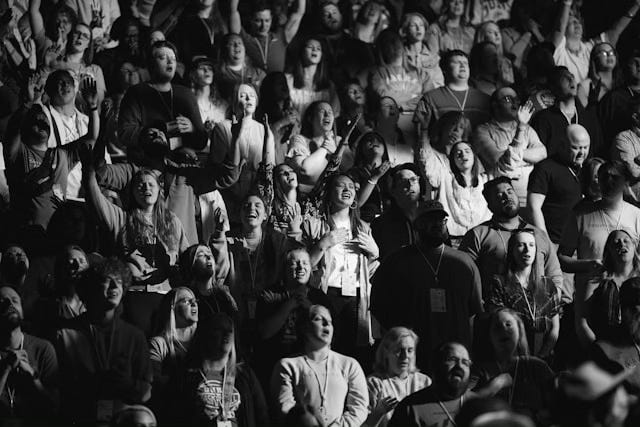
Large group of people singing

The poets and musicians may themselves be killed; those who hate freedom will continue to seek them out and murder them, but their poetry and songs cannot be put to death:

You took away all the oceans and all the room.
You gave me my shoe-size in earth with bars around it.
Where did it get you? Nowhere.
You left me my lips, and they shape words, even in silence.
~ Osip Mandelstam

And even when those lips can no longer make words, – Stalin had Mandelstam exiled and he died in transit – the words they shaped continued to be learnt by heart, whispered while tyranny reigns, but sung when freedom returns.

For there exists a deeper music to which the human soul, and the spirit of every being, responds. This music belongs to no one, which is why it cannot be locked away. It is the vibrancy, the rhythm and resonance of life itself, of infinity, of God if you will, of the sacred energy as it flows through all creation, through everything that exists. Only the hard heart cannot hear it; that is why the cruel in spirit persecute those who can.

It is this song, taught Rabbi Yehudah Aryeh-Leib of Ger, that the Children of Israel sang when Pharaoh was defeated, not on account of his death, but from the joy of liberty. And in their own song of freedom, they sung the freedom song of all creation. For the Torah says: ‘They sung this song,’ but to what does this refer? he asks, rejecting the obvious answer that it refers to the words which follow in the text. No, he insists, this points to the song that has existed from the moment of creation, the music which is present but concealed in all things, and which although so often unheard, is the invisible essence and source of energy of all that exists. It is the song of the earth ‘from whose corners we hear music;’ of the trees of the forest which clap their hands and dance, and of the wild geese, pulsing forth in honks and powerful wingbeats as they traverse the sky: ‘A voice calls out in desolate places: make straight the pathway through the wilderness for God.’ It is the song which shall be sung in the time to come, when the world is redeemed.

Is this true? One doesn’t hear such music in the headlines about brutality, murder, injustice, contempt and incitement to hatred that fill the virtual realms of social media and the press. There is little if any testament to such music in the reports from witnesses to mass killing, secret murder, torture, sadism, lying, deceit and pretence, a literature so vast and horrible that it’s unbearable to contemplate for long, but which must also be heard and heeded. Song, or sob, which is the deeper reality? The answer must be both, or else we too will join the heartless throng.

But the singing remains, inalienable, even when inaudible. For it derives from a source which flows deeper and sustains life more truly than the selfishness, fear, envy and anger, the failure of compassion and imagination, which shrink the heart.

And were it not for this singing, humanity would have no hope.

A New Year For Trees – A New – or Ancient? – Way to See The World.

In theses turbulent years, when there is so much uprooting and destruction, Tu Bishevat celebrates planting and growth. Destruction can come in moments; planting takes planning, patience, years and generations. Destructiveness drives God’s spirit into ever deeper hiding, but when we plant, carefully and appropriately, we are partners with God in creation and honour the presence of God which dwells in all living things.

Tu Bishevat began as a tax fixture, a day for determining which fruits were to be tithed in which year. (Mishnah Rosh Hashanah 1:1). But it was the kabbalists in sixteenth century Sefat who made it a date for celebration and prayer, an invocation to God’s presence which, though hidden in this world of concealment, dwells in all life. They composed this beautiful prayer for trees in general, but especially for the etrog, the pride of all that grows and symbol of the Tree of Life, the living Torah:

O God, who brought forth trees and herbs from the earth, according to their stature and variety above, to make known to human beings wisdom and understanding, so that they might comprehend the hidden secrets…. This day is the day your work commences in the renewal of nature and the budding of the trees… (Pri Etz Hadar)

To such mystics, God is both transcendent and immanent, infinitely beyond human comprehension, yet present in the smallest particles of everything that is, and, most especially, within the secret heart of life. God’s creation was not, and is not, a one-time fiat, a once-off ‘let there be’, but a continuous flow of sacred energy, bringing vitality to all existence. That’s why planting, tending, and attending to, the life of grasses, shrubs and trees is not just a physical activity of prime importance, but an act of spiritual engagement. It reminds us that we are part of an organic flow of life, interdependent with all creation.

Willow Catkin Nature Winter - Free photo on Pixabay

Tu Bishevat therefore reminds us not just of the need to return to a deeper scientific, but also to a humbler and more profound spiritual, understanding of our connection with everything around us, mineral, vegetable, animal and fellow human. It marks our need for a change in our deepest habits of awareness, the move from a utilitarian and exploitative orientation to the world towards a relationship of partnership, respect and appreciation:

We experience ourselves, our thoughts and feelings, as something separate from the rest – a kind of optical illusion of our consciousness. This delusion is a kind of prison for us… Our task must be to free ourselves from this prison by widening our circle of understanding and compassion to embrace all living creatures and the whole of Nature in its beauty. (Albert Einstein)

There are two great spurs to this reorientation. The first is pragmatic, encapsulated in the commandment bal taschit, do not destroy: the urgent need to cease from behaviours which burn, poison, pollute and render the world uninhabitable, initially for other species but ultimately also for ourselves. The Talmud contains the famous parable of the man who drills a hole under his seat in the boat, claiming that, after all, it’s only his place so he can do as he likes, an ancient version of ‘Drill baby, drill.’ As Jews, human beings, creatures of this living earth, we must join the counter-cultures of the innumerable groups across the globe who’re planting, regenerating, rewilding, re-nurturing the earth and tending all creatures from beetles to elephants in defiant commitment in every locality.

The second great motivator is wonder. Maimonides understands this as the true meaning of loving of God:

When one contemplates God’s wondrous and great deeds and creations and appreciates God’s infinite wisdom that surpasses all comparison, one will immediately love, praise, and glorify God, yearning with tremendous desire to know God’s great name, as David said: (Psalm 42:3) “My soul thirsts for God, the living God” (Laws of the Foundations of Torah 2:2)

If that sounds too pious, this beautiful poem ‘I Know Nothing’ by Malka Heifetz Tussman puts it more gently:

I don’t know when [the trees] cry,

I don’t know when they laugh,

I know nothing about such things.

It is a beautiful acknowledgment that trees have their language and moods, and that, largely ignorant before the mystery of their communications, our soul recognises its connection:

And I, –

quiet multiplied by quiet

did not interrupt my quiet prayer…

(Malka Tussman, trans.from the Yiddish by Marcia Falk)

Tu Bishevat, and its partner date Aleph be’Elul, increasingly recognised as the Jewish New Year for Animals, are days to acknowledge this kinship, and determine to live accordingly.

International Holocaust Memorial Day 2026

On Monday I attended the Foreign and Commonwealth Office, with Joe Carlebach, representing Masorti Judaism at the Government’s Holocaust Remembrance Day Ceremony, co-hosted by the Embassy of Israel. The theme is Bridging the Generations. It is a deeply affecting ceremony.

After a robust speech, Foreign Secretary Yvette Cooper takes Mala Tribich’s hand and helps her to the platform. Mala, wonderful, eloquent and brave as ever in her mid-nineties, tells how she’s a hidden child before being taken to the Czestochowa ghetto where she’s made responsible for her five-year-old cousin Anna. After years of slave labour she’s sent to Ravensbrueck and finally Bergen-Belsen, where, sick with typhus, she is liberated by the British Army.

The El Malei Rachamim, sung by Jonny Turgel, penetrates deep into the heart.

But remembrance, Yvette Cooper stresses, is not enough. ‘Memory must be combined with resolve,’ the determination to remove antisemitism and all forms of religious and race hatred from across our society. Meg Davis, Young Ambassador for the Holocaust Education Trust, tells of the gross ‘so-called Holocaust jokes’ she faces on social media. Hatred and bigotry must be confronted with education and more education.

Poignant about the past, pertinent about the present, this is a profoundly affecting gathering.

Tonight I’m speaking about my own father’s relatives from my book My Dear Ones: One Family and The Final Solution.

International Holocaust Memorial day cuts deep for all of who live and love our Judaism, and, tragically, for many other peoples as well.

What the dog has to say

Our first dog Safi used to sing. There were many variants, but two basic melodies, though it would take either a considerable amount of generosity, or a canine ear, to call it that, and what other dogs thought of his music we were never able to ascertain. The first was performed by him whenever we travelled by car and left the motorway to slow down along some country lane. Realising we were close to our destination and that he was about to be set free among the trees and streams, he would, well, there’s not really any other word for it, lift up his voice and sing. It wasn’t exactly harmonious, but it was definitely joyous, and we all enjoyed it. It touched something visceral in us all, a place of freedom, release from the city, liberation from the human equivalent of being kept on the lead. We loved it. Years later, we still say to each other as we drive up to Nicky’s parents’ home among the apple orchards in Kent, or stop by some favourite New Forest glade: ‘Remember how Safi used to sing when we got here.’

If that was his Beethoven, his second kind of melody was, without wishing to insult them, his Rolling Stones. He loved to hang on to those tough long ropes tied from thick boughs in woods or over streams for children to swing on. The moment he caught sight of one he would be off. With a flying leap he would catch on to the rope with his teeth and sway backwards and forwards, his paws waving like a hyper, but not very good, dancer at a pop concert, while something between a yowl and a whine emerged from his mouth so loudly that on several excruciating occasions the unrepeatable sound drew a small crowd to the sight. The only way to get him back was to grasp his collar, prize his teeth apart and keep holding on to him until we were at least a hundred yards away. This was especially embarrassing if the rope hung over water and a group of teenage spectators had gathered to watch.

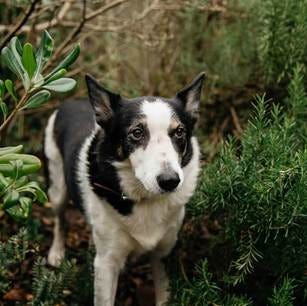
Our other dogs have, thank goodness, been more circumspect. Well, that’s not exactly true. Our second dog, Mitzpah, reputedly a pure-bred Welsh border collie whose relatives sorted sheep in the valleys, would bark at anything, except when someone came to the door or when he himself wanted to come back in from the garden. We loved him dearly, but ‘annoying’ would be too mild a term to describe his choice of when and where to be vocal. He could bark and bark, then bark and bark some more. He had his favourite places, like outside the bathroom or on the stone steps into the garden. We did sometimes wonder, though, if he could see into a dimension we could not and had taken it upon himself to frighten off ghosts hidden behind the walls or stuck for ages in our toilet, the door to which soon bore scratch-markings from his frustration at being unable to enter and chase away whatever spirit he seemed to be convinced abided there. But should a burglar have attempted to enter, we were convinced that Mitzvah would have greeted him with eager-eared silence.

Nessie, our third and current dog, as much loved or, arguably, even more than her predecessors, generally prefers paw language. Her choice of vocabulary is not always subtle. Stop stroking her and you are liable first to be tapped, then scratched and finally all but spanked by her front paw. She has a different tactic at nighttime. If she gets too cold sleeping on our bed, (our determination not to let her do so lasted less than twenty-four hours) she creeps up to you, whether you are awake or asleep, and licks your ear. We don’t need google translate to understand that this meant ‘lift up the covers because I want to crawl into bed next to you.’

However, if we are brazen enough to leave her anywhere even for a few moments, she goes vocal to a degree which makes up for all her previous reticence. If I dare to tie her lead to the post outside the shop, which I do only when we are seriously short of basics, before almost literally running round the store so as not to abandon her for more than sixty seconds, I can be certain that nobody has nabbed her because her yelps and yowls are audible down every aisle. If I’m ever in a dog-friendly café and need the loo, she follows me to outside the door where she whines so pitifully that I can’t help but embarrass myself, and probably everyone else in the establishment, by keeping up a steady ‘I won’t be long; yes I do love you; no I haven’t forgotten you,’ from inside my cubicle where I can’t complete my essential business fast enough.

If each of our three dogs had their preferred mode of self-expression, one means of communication has nevertheless been shared by them all. It has nothing to do with their vocal cords and everything to do with their eyes. It’s how they stare at you while you’re eating. Squatting motionless next to you, except for an occasional hopeful wag of the tail, totally focussed, with a pitiful and pleading look you would be forgiven for thinking they had perfected in the mirror for months, they gaze up at you unflinchingly as if to say: ‘How can you stuff your face like that when I haven’t eaten a morsel for weeks? Plea-ea-ea-se!’ Bad listener as I sometimes am, how can I fail to hearken then?

But all this is only the tip of the tale. This is merely the dog vocabulary we humans can readily understand, the equivalent of ‘bon jour means good morning in an old-fashioned guidebook for first-time tourists in Paris. See two dogs together, as when our children and their resident hounds join us, and there is a sophisticated language of interactions which we can only guess at by inter- or misinter- preting their behaviours. The old notion that what distinguishes homo sapiens from all other species is that we alone have language needs to be taken back to its kennel and left there. The actual truth is that there are innumerable languages among countless species; only we just don’t understand. ‘That’s right,’ I mentally hear my dogs assenting, ‘You just don’t understand!’

Can I please add – if you do love animals:

I have been working with two dear colleagues, Rabbi Charles Middleburg and Rabbi David Mitchell, on a prayer book for animal companions. This has been in the making for several years and we are now in a position to publish. We’re are officially launching a pet companion’s prayerbook to support us and our beloved fur-balls through every moment of joy and sorrow. 150+ pages of prayers, readings and meditations for every magical and heartbreaking stage of loving a pet, as well as appreciating the animal world.

However, we need your support to sponsor a small (or even large) section in memory or celebration of your beloved animal companion. The crowdfunding is live. https://www.kickstarter.com/projects/izzun/an-animal-siddur

Please be in touch if you would like to sponsor a line, a pawragraph or a page

What Drives Us Apart; What Brings Us Together.

We watch and pray with deep concern for Iran, Israel and all the region. As we read in the Torah of how the Children of Israel rise up against slavery, we think of the courageous people across Iran who are risking their lives protesting for freedom and democracy, and we mourn with the families of the thousands who have been brutally killed.

I so didn’t expect it. It happened almost two years ago but I still feel it. I’d half walked, half run, to Whitehall after the Shabbat service to join the mass gathering of all Britain’s organisations that care about nature. Tens of thousands were there, from RSPB members dressed like birds, to Friends of the Earth, and you name it. We were showing the next government, whoever that might be, that people care about nature.

I was anxious, for reasons you’ll understand, about being visibly Jewish in such a crowd. As I stood there, two Imams rushed towards me: ‘My brother,’ they said, embracing me. ‘We care about this together.’

Those hugs kept my heart warm even when, a mile away on the route home, I walked round a small but noisy crowd of ‘From the River to the Sea’ drumbeaters.

I needn’t emphasise here how deeply disturbing and frightening a time this is to be Jewish, though I do want to stress the deep resilience and love of Judaism which, whatever our politics, sustains us and our communities.

I’m aware that many Muslim people have their own feelings of fear: “I guess most Muslims would say that they are perceived as either a security issue, a cohesion issue or an immigration issue.” Those words, from a Muslim leader, come from the 2025 report Questions of Hope Not Hate, launched this week.

It’s a highly important document. ‘We’re not just in an era of change, but in a change of era,’ said its co-author. The report notes the negative impacts of fatigue with democratic institutions, distrust in politics, growing populism, ‘identity-based mobilisation’, and a widespread sense of marginalisation, all of which drive people apart.

Where, then, does the report find hope? In local initiatives, where people meet, talk, share common concerns, drawn together by respected communal leaders, like clergy, mayors: – these groupings remain strong, and are ever more important.

I’m writing from Rose Castle, near Carlisle; it’s a centre for interfaith, reconciliation and conflict resolution. Tonight, Nicky and I are hosting a Shabbat dinner for the second week running, with Torah and prayers, and a table of almost entirely non-Jewish guests, who then share from their own spirituality.

My friend Andy Lester came last week; he’s head of conservation for A Rocha. He told me about his church in Carlisle: ‘This is messy space,’ the minister said on his first visit: ‘If you don’t like that, this isn’t for you.’ But he does like it. ‘It’s the most diverse community I’ve seen outside London,’ he explained: ‘people with African, Asian, East European backgrounds all together, and locals who walk miles to be there. ‘Come this Sunday. There’s the baptism of a man who’s been homeless.’ I missed it, but will go next time and I’m sure my heart will be opened. On the infrequent occasions I attend worship of other religions, I feel taken to the depths of my Judaism and strengthened both in my own faith and in the appreciation that the one God gives breath to us all.

Andy is in no way sentimental: ‘The forces are growing that want to drive us apart. That’s why we must deepen the bonds of togetherness now.’ He’s referring mainly, but not only, to humans: he can identify two-and-a-half thousand kinds of bird.

After the vile murders on Bondi beach, a Christian colleague, a Muslim colleague and I went with a small group of fellow-travellers first to a synagogue where we shared teaching from Islam and Christianity, then to a church where we learnt Torah. These things matter.

We can’t unmake the horrors or disregard the fears. But we can stand together as people who care about God, community, compassion, each other and our kinship with all life.

Get in touch...