It was a wonderful privilege to be invited to attend the installation ceremony at Canterbury Cathedral of the one hundred and sixth Archbishop of Canterbury. As the formalities moved to a close, the Dean invited the congregation to ‘greet our newly installed Archbishop.’ A huge cheer went up, and the applause continued for many minutes.
The applause was for Sarah, a woman who had come from the profession of nursing to follow the call of her God, a person free from pretensions, determined, as she declared, to ‘travel with you in [God’s] service.’ This ‘you’ included children, people of all faiths, and communities from across the globe. Songs, readings and prayers were shared in Spanish, Urdu and Swahili.
The applause was because, for the first time in the history of the Church of England, a woman occupied the Chair of St Augustine. The cheering was for humanity and hope.
This was an island of grace in the midst of all the fighting in the world.
It is special to have as Archbishop a person who has already visited our synagogue. It was a joy to see next to her the Bishop of Dover, Rose Hudson-Wilkin, with her beaming warm smile, who sung ‘By the Rivers of Babylon’ so unforgettably in our community’s celebration of the completion of a study of the Psalms.
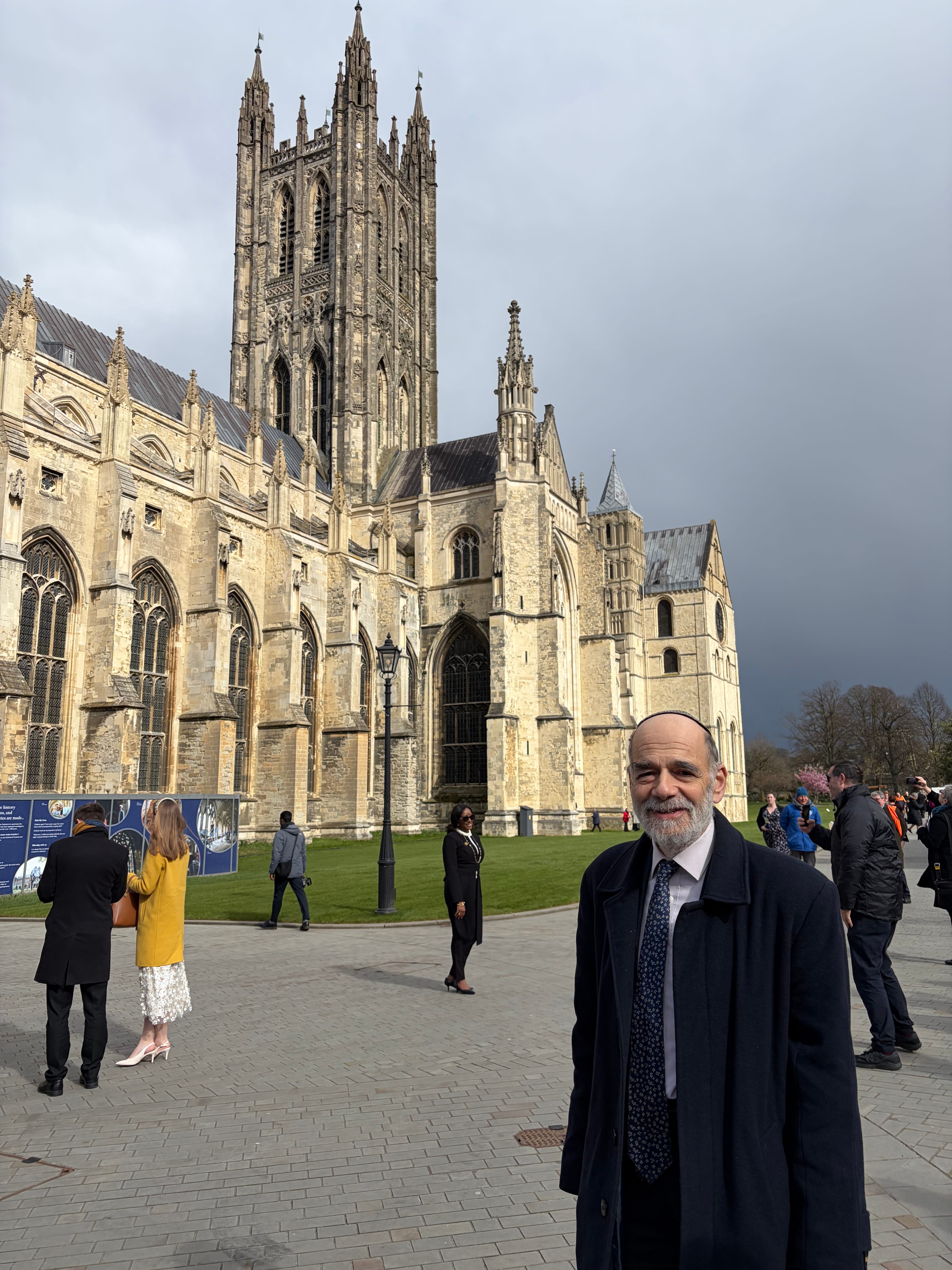
Guests of other faiths were seated in a block at the front, past the nave. Presently, some hundred bishops and metropolitans processed in to sit in the area opposite us. Momentarily, I had the wicked thought: what would happen if a football was dropped in the middle between us? But there were many smiles across the isles, proving that interfaith relations are, despite everything, far from dead. For a moment I half-wondered of whom I knew more: bishops or rabbis.
Then I reflected: Here is Bishop Kenneth Nowakowski (I sneaked across the aisle and we gave each other a hug). How do I know him? From prayers at the Ukrainian Cathedral, more intense year by year, for an end to the invasion of his country, and from the tears he wept at the pulpit of my synagogue. Here is Greek Orthodox Archbishop Nikitas: how do I know him? Because he served in Sarajevo, during the longest siege of the last century and because we visited Ukraine together. There is Coptic Archbishop Angaelos: we’ve shared reflections on the persecution of our peoples. Next to me sits Qari Asim: he sends me a warm, heartfelt message whenever there is yet another outrage against Jews and synagogues, and I do the same when Muslims and mosques are attacked. There sits Sayed Razawi: we know each other from the Drumlanrig Accords, and because we’ve lit candles together in the presence of Scotland’s First Minister, with prayers that race hate should gain no inroads in his country. These are the sorry, but significant, contexts in which I know these leaders of fellow faiths.
But this was a moment of grace, joy, togetherness and celebration, in the midst of all the bombs and drones falling in Jerusalem, Beirut, Tehran, Lviv, Kyiv.
So was this, then, a sweet delusion, an aside amidst the world’s strife?
No. I was mindful that we stood close to the altar where a previous incumbent of the office of archbishop, Thomas Becket, was murdered in 1170 for telling truth to power. Thus, there was beauty in these moments here in 2026, but there was also sharp reality. We, of all faiths and none, understood that what must bind us together is the service of a higher, deeper, more enduring truth than hatred, divisiveness and blame.
At the end of the service the new Archbishop called out:
‘I invite you as faith leaders to commit to serve together.’
We replied with one voice:
‘We commit to serve together as people of many faiths, in a spirit of friendship and co-operation, to help bring about a better world now, and for generations to come.’
So, despite everything, may it be!