The Shabbat before the rally against antisemitism:
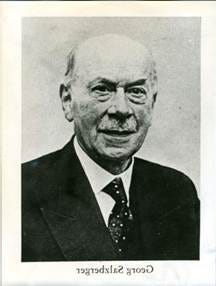
I hear my grandfather say those words Mei’ayyin kochacha gadol – From where does your strength come?’ Someone surreptitiously recorded him when he preached on this theme in Berlin in his late eighties. In the Bible the question is a trick: it’s what Delilah, urged by her Philistine family, asks Sampson in order to find out the secret of his power and betray him.
But for my grandfather, Rabbi Georg Salzberger, the words transcended their context: they were the question that framed his life from his years under Nazism in the Frankfurt of the 1930’s, through his flight to England until the end of his days as a refugee, ‘a brand plucked from the fire.’
From where does your strength come? -That question is painfully and acutely relevant today when antisemitism is resurgent once again, from the far right, the far left and militant Islamist groups. Though we Jews are now in the front line, race-hate against Muslims, anti-refugee rhetoric and hate speech have spread angrily across society, inciting bigotry, division and violence, and spreading fear and distrust. It is sad to be writing these words on VE Day, dedicated to marking the defeat of Nazism, fascism and the end to a terrible war.
Where, then, does our strength lie?
It rests in community, our care for each other, our solidarity despite our differences, our concern for each other’s wellbeing. It lies in the awareness, care and compassion we show to one another throughout our life’s journeys. Judaism teaches us always to be part of community.
This leads to a deeper, prior question: what makes our community strong? The answer, throughout Jewish history, whether in times of persecution or peace, lies in Torah. The teachings of Torah give us the rhythm of our week around shabbat, our year around the festivals, and our life from birth to death. They instil in us the overriding values of justice and compassion, breaking them down into specific acts, mitzvot, from how to bake bread to how to share it with those who need. The details of these mitzvot have been filtered through generations of debate and sensitivity in an unfinished process in which we are called to engage. (I have tried to summarise this in the accompanying very short video to be added shortly)
Thus, community and Torah are the roots of Jewish resilience, faithfulness, and, in times of oppression, steadfast defiance.
But what underlies Torah? This was the question debated by Rabbi Akiva and his student companion ben Azzai two thousand years ago: Love your neighbour, said the former. All humans are made in God’s image, said the latter. Taken together, their responses mean respecting the presence of God in every human being and treating all persons, whoever they are, with justice and compassion. I trust this is what will be expressed in next week’s A Million Acts of Hope (https://millionactsofhope.org/)
Deeper even than this, is the consciousness of the divine within all the world, not just in humanity but in all life, commanding our respect for the whole of nature. The experience of wonder at creation, defined by Maimonides as the love and awe of God, has the power to inspire us and restore our spirit when we feel frustrated, hopeless and washed out. Music, poetry, beauty and the companionship of non-human as well as human life are therefore also essential resources for our resilience and inner strength.
So from where does our strength come? It comes from solidarity, solidarity as Jews with our own people, solidarity with all people of good faith from all faiths, solidarity with all life, solidarity with God’s presence within all creation. These are the secrets of our strength.
As a p.s., I shall be deeply upset and dismayed if Nigel Farage speaks at the rally.